Product rendering for luxury goods & jewelry: a practical guide for b2b brands

Selling jewelry online comes with a unique challenge: your customers can’t touch the metal, feel the weight of a piece, or see how a diamond catches the light when they move. All they have is what you show them on screen. And for luxury goods, where every detail matters, that’s a huge responsibility.
That’s where product rendering comes in. Also called 3D visualization or CGI (computer‑generated imagery), this technology lets you create photorealistic images of jewelry entirely in software. No studio, no camera, no physical prototypes required. Just stunning, lifelike visuals that look as good as—or better than—traditional photography.
Why luxury brands are switching to 3D rendering
Key elements of high‑end jewelry rendering
Trends Shaping Luxury Jewelry Visualization
In this guide, we’ll walk you through what product rendering is, why it’s becoming the new standard for luxury brands, and how it can help you sell more while saving time and money.

What is product rendering for jewelry?
Product rendering is the process of creating realistic digital images of a product using 3D software. Think of it as a virtual photoshoot. Instead of setting up lights and cameras in a studio, a 3D artist builds a digital model of the jewelry piece—often from a CAD file or even a simple sketch—and then applies lifelike materials, textures, and lighting to generate an image that’s virtually indistinguishable from a photo.
For jewelry, this means capturing the sparkle of a diamond, the warm glow of rose gold, and the intricate details of a pavé setting, all before the piece has ever been manufactured.
You can see examples of our work in our portfolio or learn more about our photorealistic 3D product rendering services.
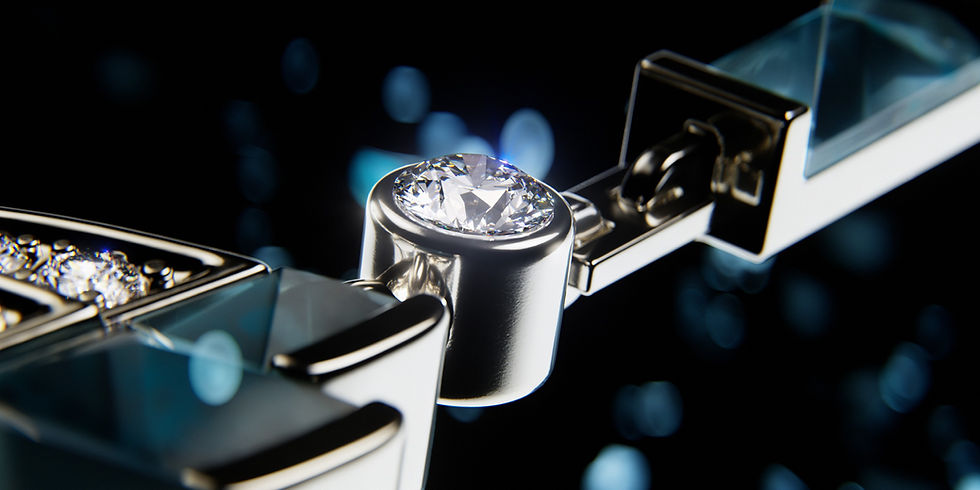
Why luxury brands are switching to 3D rendering
For years, traditional photography was the only way to showcase jewelry online. But photography has serious limitations, especially for luxury goods. Here’s why more B2B brands are making the switch to 3D rendering.
1. Photorealism that builds trust
Luxury shoppers expect perfection. If a diamond looks flat or the metal feels “off,” they’ll scroll past. Done right, 3D rendering produces images that look so real, customers can’t tell the difference from a photo. Every curve, shadow, and sparkle mimics how the piece would behave in natural light. This builds instant credibility—and in a world full of knockoffs, credibility equals conversions.
2. Infinite variations without inventory risk
Want to show the same ring in yellow gold, white gold, and rose gold? Or swap a diamond for an emerald or sapphire? With traditional photography, that means shooting each variation separately—expensive and time‑consuming. With 3D rendering, one model unlocks dozens of variations with a few clicks. You can test‑market new combinations, offer personalized previews for custom orders, and expand your product catalog visually without ever touching your inventory.
3. Faster time‑to‑market
With traditional photography, you need physical prototypes for every piece you want to shoot. That means waiting for manufacturing, shipping samples, and scheduling studio time. With 3D rendering, you can have perfect product visuals ready for your website and marketing campaigns before the first piece is even made. This allows you to launch new collections faster and respond to market trends in days, not months.
4. Perfect consistency across your entire catalog
Getting the same lighting, angles, and backgrounds across hundreds of product photos is nearly impossible. Shadows shift, reflections change, and colors vary from one shoot to the next. 3D rendering guarantees flawless consistency: every image, for every product, has the exact same lighting, angle, and background. This creates a professional, cohesive brand experience that builds trust with high‑end buyers.
5. Cost‑effective at scale
Yes, there’s an upfront investment in creating the 3D model. But once the model exists, generating additional images—different angles, backgrounds, or product variations—costs very little. For large collections with many variations, the cost per image is dramatically lower than traditional photography. Plus, you eliminate ongoing expenses like studio rentals, photographers, and product shipping.
Want a deeper comparison? Read our full guide: 3D rendering vs traditional photography.

Key elements of high‑end jewelry rendering
Not all 3D renders are created equal. For luxury goods, the difference between “good” and “exceptional” comes down to a few critical factors.
Lighting
Lighting makes or breaks jewelry rendering. Diamonds and gemstones need precise light to reveal their brilliance. Professionals use HDRIs (high dynamic range images) to simulate real‑world lighting environments, ensuring metals reflect naturally and gems sparkle from every angle. The goal is to make the piece look as if it’s sitting under perfect studio lights.
Materials
Gold, platinum, silver—each metal has unique reflective properties. Gemstones require accurate refraction and dispersion settings to capture their “fire.” Professional rendering artists use physically‑based rendering (PBR) materials that behave exactly like real metals and stones, down to the way light bends through a diamond.
Textures
Luxury jewelry isn’t just shiny. It has brushed finishes, engraved details, and subtle surface textures that give it character. High‑resolution texture maps bring these details to life, making the digital piece feel tangible and real.
Composition
How the jewelry is presented matters. Whether it’s a clean white background for e‑commerce or a lifestyle shot on a hand model, the composition should highlight the piece’s best features without distraction.
Get our Capabilities Deck
Discover how Transparent House can elevate your brand with world-class CGI, animation, and immersive content. Fill out the form to instantly receive our latest portfolio and service overview to your email.

The ROI of 3D product rendering for luxury brands
The numbers speak for themselves. Brands that add 3D content to their product pages see dramatic improvements in engagement and sales.
Higher conversion rates: Studies show that 3D visuals can increase conversion rates by up to 94%. For luxury jewelry specifically, brands using 3D rendering have reported conversion rates of 11.2% compared to just 1.9% with traditional photos.
Lower return rates: Customers who can see a product from every angle before buying are far less likely to return it. Returns can drop by as much as 35‑40% when shoppers preview items in 3D.
Better engagement: Products with 3D imagery generate 50% higher user engagement compared to static images.
For B2B luxury brands, these metrics translate directly to higher average order values, stronger customer loyalty, and a clear competitive edge.

Trends shaping luxury jewelry visualization
The industry is moving fast. Here are a few trends every luxury brand should watch.
Real‑time rendering and AI
New AI‑based tools can generate 360° product views from just a few smartphone photos or a single CAD file. This dramatically accelerates content creation and makes real‑time customization possible.
Virtual try‑on (AR)
Augmented reality lets customers “try on” rings, necklaces, and earrings using their phone cameras. This removes the biggest barrier to online jewelry sales: the uncertainty of how a piece will look on a real person.
Hyper‑personalization
Customers increasingly expect to co‑create their jewelry. With 3D configurators, they can choose metals, gemstones, and engravings in real time, seeing exactly how their custom piece will look before they buy.

Frequently Asked Questions (FAQ)
Do I need a CAD file to start with 3D rendering?
Not necessarily. While CAD files are ideal, many rendering studios can work from hand‑drawn sketches, photo references, or even just a detailed description of the design.
Is 3D rendering more expensive than traditional photography?
For small, simple product lines, photography may be cheaper. But for large collections with many variations, 3D rendering is far more cost‑effective at scale. Once the 3D model is built, generating additional images costs very little.
How realistic can 3D renders get?
With modern rendering technology and skilled artists, 3D renders can be virtually indistinguishable from high‑end photography. Many major luxury brands now use CGI for most of their product imagery because the realism is that good.
What file formats do you need?
Common formats include STL, OBJ, STEP, IGES, and 3DM (Rhino). If you don’t have a 3D file, we can help create one from your reference materials.
How long does the rendering process take?
Timelines vary depending on complexity. A single ring might take 1‑2 weeks from modeling to final render. A full collection with multiple variations could take several weeks. We always provide a clear timeline upfront.
Can I use 3D renders for marketing and advertising?
Absolutely. 3D renders work perfectly for websites, social media, email campaigns, print catalogs, and even video ads. You can also create 360° spins and animations to showcase your pieces in motion.
How do I choose the right 3D rendering partner?
Look for a studio with proven experience in luxury jewelry, a strong portfolio, and a clear process for collaboration. They should understand the unique challenges of rendering metals and gemstones and be able to deliver consistent, high‑quality results on time.
Ready to see how 3D rendering can elevate your luxury brand? Explore our 3D visualization services or browse our portfolio for inspiration.


